Mesh back
Choose mesh, half-mesh or perforated back and see the see-through panels render live.
A trucker cap is two caps in one: a structured front that holds decoration, and a mesh back that mostly holds air. Get that split right and everything else follows — foam or twill front, flat or curved brim, snap closure, rope trim. Build it on a live 3D model, hold a physical sample, then run it.
Design it in the browser, on iPhone or on iPad — nothing to install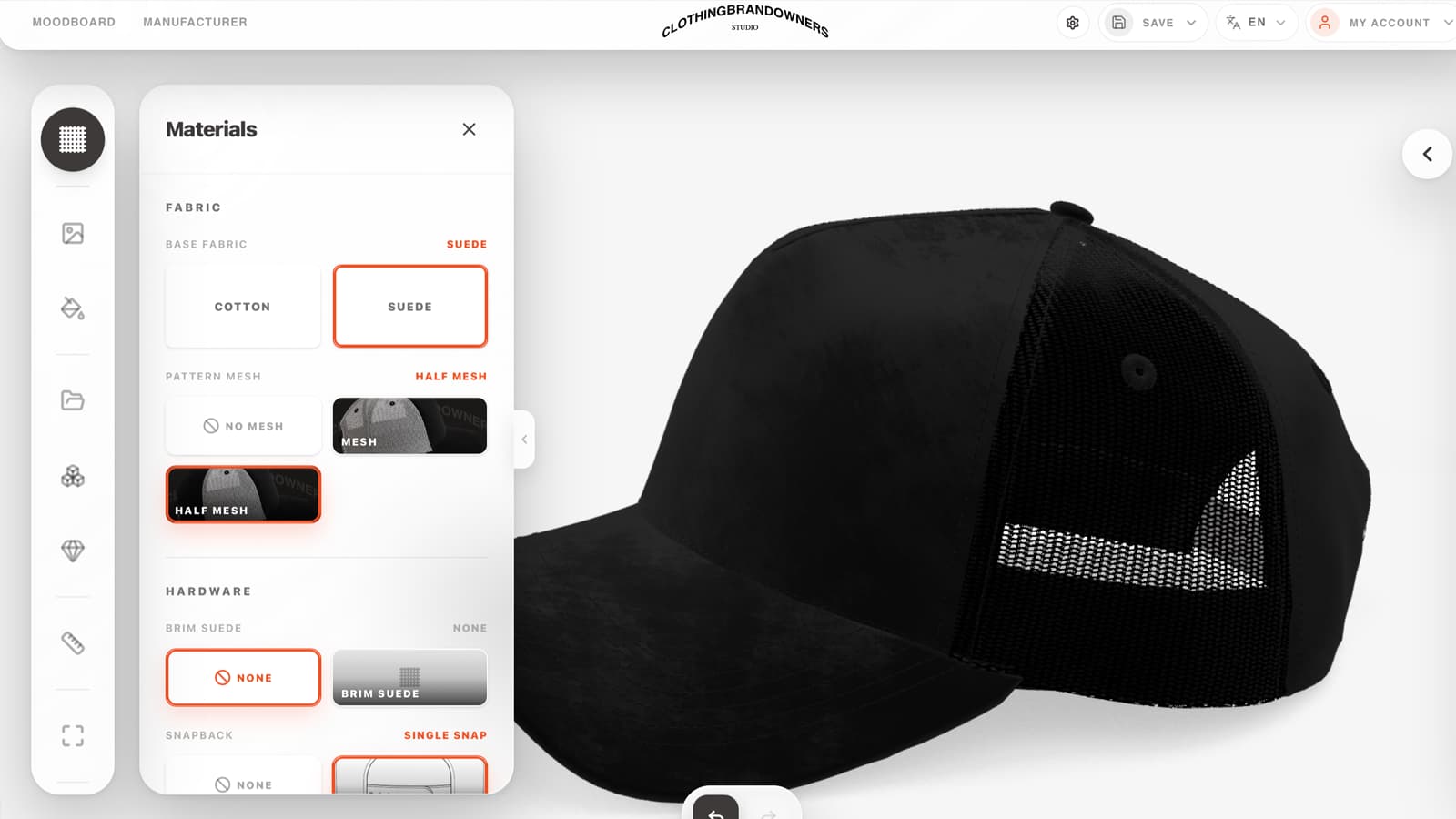
These are real options in the CBOs Studio — what you preview is what the factory is asked to build.
Choose mesh, half-mesh or perforated back and see the see-through panels render live.
Heavy cotton, cotton, suede or corduroy on the front panels, with a suede brim option.
Drop your logo on the curved front and preview flat embroidery, 3D puff or print effects.
Snap closures, eyelets, rope details, metallic top buttons and labels.
The trucker silhouette decides your decoration before your artwork does. Everything heavy goes on the front; the back panel is there to breathe. Our custom embroidered hats reference spells out how each build behaves on the machine.
Foam or twill front panels backed with buckram hold their shape, and that backing is exactly what raised embroidery needs. A high-crown structured trucker front handles bold 3D puff logos up to about three inches — the tallest decoration on the cap.
Plastic or soft mesh, paired with the foam or twill front. In production the mesh panel normally stays blank or carries small flat embroidery only: it has no backing, so it cannot support puff, dense fills or heavy patches.
Flat brims stay rigid and keep the retail sticker on; curved brims arrive pre-shaped. A rope adds a thin cord along the brim seam — a detail borrowed from rope caps that reads instantly on a trucker.
Sewn, metal or laser-cut eyelets, matched to the front fabric — or none at all. Inside, a standard cotton band, a moisture-wicking band or a printed band carrying your brand name or a repeating wordmark.
Both are “truckers”, and they photograph differently, fit differently and take decoration differently. Pick the build first, then the artwork. The full construction matrix lives in the cap production capabilities sheet.
Six panels, foam or twill front, high crown with a pronounced front shape, flat brim with a rope option. The tall front is the one streetwear brands use because it gives puff embroidery and leather patches room to sit without touching the brim.
A five- or six-panel build, mid-to-high crown, flat or curved brim, structured front and snap closure. Lower and less aggressive than an A-frame — the safer read for a merch cap, a shop cap or a first drop.
If the logo is a bold wordmark or a shape you want raised, take the A-frame crown. If it is fine linework or a patch, the classic build keeps proportions calmer. Undecided brands usually sample the A-frame and compare it against a full-fabric snapback before committing a run.
A structured trucker front is the friendliest surface CBOs makes for raised embroidery: buckram behind the panel, a tall crown above the brim and no seam interruption if you stay off the center line. The mesh back is the opposite — plan a woven label, a small flat mark or nothing at all.
See embroidery and patch methodsFour steps, and the third one is the one most brands skip: deciding the back before the front.
Open the six-panel trucker in the browser on desktop, iPhone or iPad. No install, no credit card — the cap loads already built, with the mesh back attached.
Choose mesh, half-mesh or perforated, then recolor the front panels. Fabric-aware fill changes the color while the weave of the cotton, suede or corduroy stays visible.
Drop your artwork on the front and switch between flat embroidery and 3D puff to see how much height the design can carry before the detail closes up.
One physical trucker for $60, usually about 7 days. Approve the real cap and production runs from 50 pieces with your own labels inside.
Most trucker hat sites let you place a flat logo on an existing blank. CBOs is built for brands that want their own cap — and for the hat designers who build it for them.
| Catalog customizer | CBOs | |
|---|---|---|
| The cap itself | Pick a blank from a catalog | Build panels, mesh, fabrics and hardware from scratch |
| Preview | Flat 2D proof of the front | Rotating 3D cap with real mesh and fabric textures |
| Before bulk | Digital proof only | 1 physical sample in hand for $60, about 7 days |
| Pricing | Per-blank retail pricing | Sample $60 · bulk from 50 pieces at ~$10-15/cap |
CBOs is the factory, not a decorator working on someone else’s blank. The sample-to-production route is the same one every trucker project takes.
A single physical cap, usually about 7 days. It is where you check thread color, stitch height, how the mesh sits against the front panel and whether the crown reads as tall as it did on screen.
Bulk starts at 50 pieces per model and colorway, roughly $10-15 a cap, about 14 days after you approve the sample. Two colorways means two runs — worth planning before you fall in love with four.
Woven labels, printed sweatbands, hangtags, brim stickers and retail packaging if the cap is going on a shelf. The design and its IP stay yours throughout.
None of these are expensive to fix in the 3D file. All of them are expensive to fix after 50 caps are sewn.
Thin outlines, gradients, tiny text and detailed mascots lose their definition once foam goes under the thread. Our guide on 3D puff vs flat embroidery lists the artwork that should stay flat.
A logo that looks great across the back in a flat mockup has nowhere to anchor on an open mesh panel. Move it to the front, a side panel or the closure strap before sampling.
A six-panel front is split by a center seam. Small marks and split lockups sit fine on either side of it; a single dense shape straddling the seam rarely comes back looking the way it did on screen.
Flat versus curved changes who the cap is for more than the fabric does. Decide it before the sample, because it also decides whether the retail brim sticker makes sense.
Screens are backlit and thread is not. The physical sample exists to confirm thread color, logo scale, stitch height and edge quality — that is the whole reason it costs $60 instead of nothing.
The minimum is per model and colorway. A sample proves the construction; it does not pre-approve three other fabric colors you have not seen sewn.
Not really, and it is a construction limit rather than a preference. The mesh panel has no backing behind it, so in production it normally stays blank or carries a small flat embroidery mark only. Puff embroidery, dense fills and heavier patches need the structured front panel.
Both exist. A foam front gives the tall, pronounced A-frame shape associated with streetwear truckers; a twill front reads closer to a classic cap and takes fabric options such as heavy cotton, suede or corduroy. Both are structured, so both can carry 3D puff.
On a high-crown structured trucker front, CBOs works with bold puff logos up to around three inches. Beyond the size question, what matters is the artwork: solid shapes and thick letters hold, thin lines and gradients do not.
One physical sample for $60, usually finished in about 7 days. Bulk production starts at 50 pieces per model and colorway, typically around $10-15 per cap and about 14 days after sample approval.
Yes. The rope is a thin cord running along the brim seam and it is an option on A-frame builds. It changes the read of the cap considerably, so preview it on the 3D model with your logo in place rather than adding it as an afterthought.
From scratch. Panel count, crown height, front fabric, mesh type, brim shape, closure, eyelets, sweatband and inside labels are all project decisions, not catalog constraints. That is why the sample is a real manufactured cap and not a decorated blank.
Truckers solve one problem — a structured front with a breathable back. These four solve different ones.
Same structured, buckram-backed front, but full fabric all the way around. More surface for color blocking and side embroidery.
A seamless flat front instead of a center seam. The build to take when your front graphic is one wide piece of artwork.
Suede, corduroy, leather patches, pins and retail packaging — the trucker front pushed toward a drop rather than a merch run.
Rope caps and performance fabrics for tournaments, pro shops and clubs, where the same 50-piece minimum covers one event.
Build the cap in the browser, hold one for $60, then run 50 with your labels inside.