A-panel silhouette
The A-Panel Streetwear model — the shape you see on premium drops, not a promo blank.
Print-on-demand can put your graphic on somebody else's cap. It cannot give you the cap: the suede, the leather patch, the chenille, the pin, the label inside, the box it arrives in. All of that is manufacturing, and all of it is available from 50 pieces — one drop.
Build it in the browser, on iPhone or on iPad — nothing to install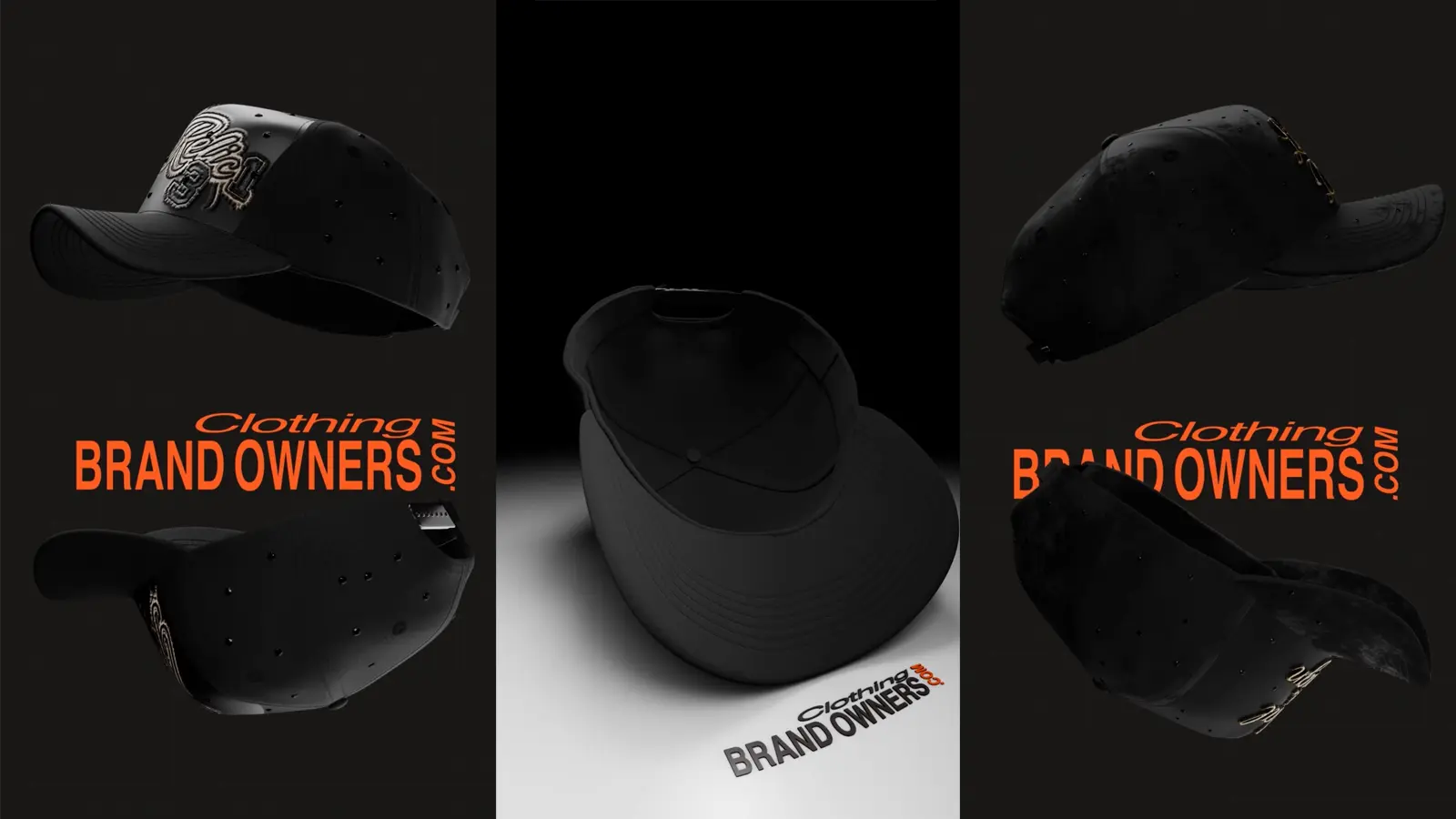
Real Studio options — what you preview is what the factory is briefed to sew.
The A-Panel Streetwear model — the shape you see on premium drops, not a promo blank.
Premium fabrics with fabric-aware recoloring: build colorways with the texture alive.
Paint rhinestones directly onto the crown and preview puff embroidery with real displacement.
Rigid boxes, dust bags, hangtags and woven labels — design the unboxing, not just the cap.
Streetwear does not have one cap; it has four, and each carries decoration differently. Every construction below is on the production capabilities sheet and can be sampled individually.
A high crown with a pronounced front shape and a flat brim — the tallest front CBOs builds, which is why it carries the biggest raised logos. On the mesh-back version it becomes the A-frame trucker.
Buckram-backed front, adjustable snap, available in five, six or seven panels. It is the pragmatic drop cap: one size fits everyone who buys it. Panel-by-panel color blocking lives here.
The premium end. High crown, flat brim, fixed sizing, and the build most able to carry metal hardware and stones — with the size-curve planning that comes with it.
Low, soft, and the only build with a genuinely seamless front panel. The shape to take when the artwork is wide, printed or patched rather than stitched and raised.
Embroidery is where most brands stop. The techniques below are what buyers notice from a metre away, and they are all standard CBOs production.
Engraved, debossed or stitched, in real or faux leather. It crosses western, heritage and streetwear at once, and on a suede crown with a flat brim it is the single most efficient way to make a cap read premium.
A soft 3D rubber patch handles gradients, icons and brand marks with depth — the artwork that embroidery flattens and puff swallows. It is the method to reach for when the logo is illustrative rather than typographic.
Fuzzy letterman-style raised letters and shapes. Retro and collegiate by default, and a natural pairing with corduroy. It adds visible texture without needing the rigid backing that puff embroidery demands.
Repeat embroidery across the panels instead of one front mark. It is premium capsule finishing rather than a logo treatment, and it changes the cost structure of a run — worth pricing before designing.
A rigid gift box with a foam insert, a cotton or canvas dust bag, a numbered authentication card with the drop name or a QR link — this is where a 50-piece run stops being merch and starts being a release. It is also the part of the product print-on-demand structurally cannot supply.
See custom cap packaging boxesOne workflow, no agency in the middle: silhouette, materials, decoration, sample, run, packaging. It runs in a desktop browser and in the hat design app for iPhone and iPad.
Open the A-Panel Streetwear model — or any of the other builds — in the browser on desktop, iPhone or iPad. Free to start, nothing to install.
Suede, corduroy, denim or faux leather, recolored with the texture intact. Mixing fabrics across panels is normal here: a suede crown with a faux leather brim is a specification, not a special request.
Patch, embroidery, chenille, pins, stones. Preview puff as real displacement and paint rhinestones onto the surface with a brush so the density is a decision rather than a surprise.
One physical cap for $60, about 7 days. Then a 50-piece drop at roughly $10-15 a cap, about 14 days, with your labels inside and your packaging around it.
POD is great for testing a graphic. It cannot give you a cap that is yours — construction, fabric, label, box.
| Print-on-demand | CBOs | |
|---|---|---|
| The product | Catalog blank, decorated | Your silhouette, fabric, trims and label |
| Decoration | Print or basic embroidery | 3D puff, chenille, patches, gems, metal pins |
| Margins | Per-unit POD pricing | ~$10-15/cap from 50 pieces, yours to price |
| Unboxing | A polybag | Rigid box, dust bag, hangtag — your brand |
CBOs is the custom hat manufacturer itself: construction, decoration, labels, packaging and quality control in one place. The sample-first route is how every drop starts.
$60, about 7 days. On a mixed-material cap the sample is not optional in practice — suede against faux leather, patch against stitch, stone density on a curve: none of it is finally judged on a screen.
Bulk starts at 50 per model and colorway, roughly $10-15 a cap, about 14 days after approval. Two colorways is two runs — a positioning decision as much as a budget one, so it is worth reading what a first drop actually costs before adding a second colorway.
Woven label, satin care label, inside taping, hangtag, brim sticker, dust bag, rigid box. Your design and its IP stay yours: CBOs manufactures the cap, it does not own the brand.
Each is a real production option on a 50-piece run, and each is planned at sample stage. They sit alongside the rest of the private label programme.
A custom rigid box holds the crown in shape and turns delivery into an event. It is the packaging limited runs and gifting sets are built around, and it changes what a customer will pay without changing the cap.
Protective, reusable and quietly effective as brand surface. It also solves the practical problem of a structured cap shipping alone in a box that has to stay lightweight.
A printed card carrying an edition number, the drop name or a QR link. On a 50-piece run, numbering is trivially easy and disproportionately convincing.
Card, kraft or plastic hangtags; matte, holographic or die-cut brim stickers. On a flat brim the sticker is part of how the product is worn, not something the customer removes.
Printed or woven tape over the crown seams carrying your name or a repeating pattern, plus a woven brand label and a satin care label. The inside is the half of the cap only the owner sees.
The unglamorous one, and the one that decides whether a wholesale account can shelve your caps without repacking them. Individual bagging with a printed label is standard retail practice.
Production starts at 50 pieces per model and colorway, which is a realistic first drop rather than a warehouse commitment. Before that you order one physical sample for $60, usually about 7 days, so the only cap you commit to while the design is moving is the one you are holding.
A soft rubber or PVC patch. It handles gradients, icons and marks with depth — exactly the artwork that flat embroidery simplifies and 3D puff loses. Woven patches suit tight linework, and leather patches suit a single engraved or debossed mark.
Yes, and in this category it is normal rather than exotic. Suede has a soft matte hand, corduroy brings a directional wale, faux leather works as a panel or brim accent and carries heavy embroidery and metal hardware. Preview the combination on the 3D model: mixed materials read very differently in cloth than as flat color blocks.
Yes. Rigid boxes, dust bags, hangtags, brim stickers, polybags with printed labels, woven labels and authentication cards are all part of the same project. The Studio also includes an animated packaging box model so the unboxing can be previewed rather than imagined.
Always. The IP of every design remains yours — CBOs manufactures your cap, it does not own your brand. That applies to the artwork, the construction specification and the finished product.
No, and that is a construction limit rather than a policy. Raised puff needs a structured front panel with backing behind it: A-frame, snapback and fitted builds all have it. Soft camper and unstructured builds do not, and there chenille, patches or print do the job instead.
Each of these pages goes deeper on one construction, with the decoration rules that come with it.
Fixed sizing, high crown, and the build that carries metal pins and heat-set stones best.
The A-frame front with a mesh back — the cheapest way to run a bold raised logo.
A seamless camper front for wide graphics, prints and square patches.
One adjustable size, five to seven panels, and the easiest drop to sell through completely.
Build the cap, sample it for $60, run 50 with your labels inside and your box around it.