Color blocking
Fabric-aware fill recolors each panel separately — two-tone crowns, contrast brims, matched snaps.
A snapback is the most decorated cap in headwear for one structural reason: the front panel is backed with buckram, so it stands up and stays put. That backing is what lets a snapback carry heavy embroidery, dense text and large raised puff that softer builds simply cannot hold.
Design it in any browser, on iPhone or on iPad — nothing to install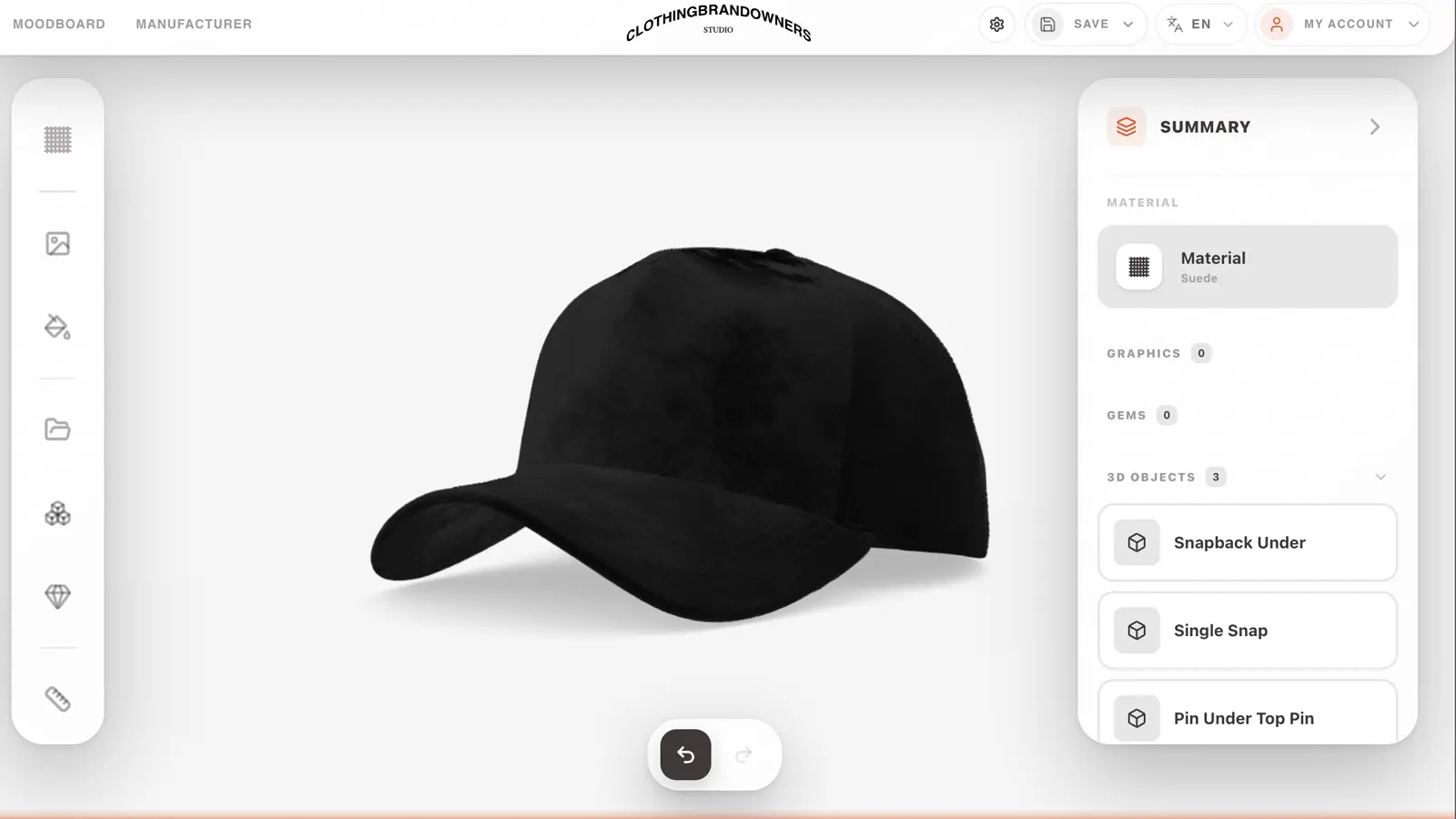
Real Studio options — recolored, previewed and rotated before anyone cuts fabric.
Fabric-aware fill recolors each panel separately — two-tone crowns, contrast brims, matched snaps.
Heavy cotton, cotton, suede and corduroy, with a suede brim option for premium colorways.
Place logos and lettering on the structured front and preview flat embroidery or true 3D puff.
Single or double snap closures, eyelets, metallic top buttons, pins and labels.
Panel count is not a spec-sheet detail on this cap: it decides seam layout, front shape and where a logo can sit. All three builds are available — the construction reference lists them side by side.
The classic snapback build. A center seam divides the front into two curved halves, which suits split lockups, arched text and marks placed either side of the line. A single dense shape laid across the seam is the one thing to avoid.
Both give flat front real estate instead of a split. Five panels come from the camper lineage and read lower; seven panels keep the snapback height while removing the seam interruption, which is why detailed front artwork often ends up there.
Mid-to-high structured crown, flat brim, suede or stitched. The flat brim stays rigid, which is what makes a retail brim sticker plausible — matte, holographic or die-cut, with your brand and size on it.
Every raised technique CBOs runs needs something behind the panel to push against. This build has it. See the full embroidery and patch methods for what that unlocks.
A stiffening layer behind the front panels holds the crown upright and stops the fabric moving under needle pressure. Without it, dense stitching pulls the panel; with it, the panel stays flat and the artwork lands where the file said it would.
Foam under the thread creates the dimensional logo effect associated with snapbacks and A-frame truckers. A structured snapback front takes puff at a size no unstructured cap can, which is why bold wordmarks live here.
Heavy flat embroidery, tight fills and multi-line text hold their spacing on this front. Drop names, city marks and retail lockups are the standard use — they need stability more than they need height.
Thin outlines, gradients, small type and detailed illustration lose definition once foam goes underneath. On those files, flat embroidery or a woven patch keeps detail that puff would swallow.
Satin lining is standard on premium snapbacks, and inside taping over the crown seams can carry your brand name or a repeating pattern. Add a woven label and a printed sweatband and the cap is finished on the inside as deliberately as on the front — the difference between a decorated blank and a product.
See private label hat manufacturingBlocking first, artwork second. Deciding the color zones before the logo saves a sampling round.
The snapback loads in the browser on desktop, iPhone or iPad with its flat brim and snap closure attached. Free to start, nothing to install.
Recolor each panel independently. Two-tone crowns, a contrast brim, a matched or deliberately clashing snap — the fabric-aware fill changes the color while the weave of cotton, suede or corduroy stays visible.
Place your artwork on the front and switch between flat embroidery and 3D puff. Puff renders as real displacement, so you are judging height and coverage rather than reading a drop shadow.
One physical snapback for $60, usually about 7 days. After approval, production runs from 50 pieces at roughly $10-15 a cap, about 14 days.
A flat template shows one angle of one blank. A snapback decision — panel colors, puff height, brim contrast — needs the whole cap.
| Flat mockup | CBOs | |
|---|---|---|
| Angles | One fixed front view | Rotate the cap: crown, side panels, brim, back |
| Materials | Painted-on texture | Real suede, corduroy and cotton with live recoloring |
| 3D puff | A drop shadow effect | Displacement that actually raises the embroidery |
| Next step | Export a JPEG | Order the physical sample of that exact cap — $60 |
The cap is built for you, not pulled off a shelf and decorated. Every project runs through the same one-sample-then-bulk route.
About 7 days for a single physical cap. On a color-blocked design the sample earns its money immediately: adjacent panel colors behave differently in cloth than they do lit on a screen.
Bulk starts at 50 per model and colorway, roughly $10-15 a cap, about 14 days after approval. A black-on-black and a cream version of the same snapback are two runs, not one.
Brim sticker, hangtag, polybag with a printed label, woven label and boxed packaging for limited drops. Your design and its IP remain yours.
Blocking is the cheapest way to make a snapback look designed. It is also where the most avoidable sampling surprises come from.
Panel count sets the ceiling. Six panels give you a front pair, two side pairs and a back pair; seven and five reshuffle that entirely. Decide the build before you plan a three-color crown.
Top and underside can differ, and a suede or stitched brim reads differently again from a plain one. It is the highest-contrast area on the cap and the easiest place to add a second color without noise.
The plastic snap closure is adjustable and visible from behind in every product photo. Matching it to the crown disappears it; contrasting it makes the back of the cap a design element.
Sewn, metal or laser-cut, matched to the fabric of the panel they sit in. On a two-tone crown, mismatched eyelet treatment between panels is the detail that reads as a mistake rather than a choice.
Contrast stitching runs along every seam you have just color-blocked, and printed or woven inside taping repeats the idea where only the wearer sees it. Both are decided at sample stage, not after.
A suede front with cotton sides, or a corduroy crown with a suede brim, is a normal request. Preview the mix in 3D — the streetwear builds lean on this more than any other style.
A buckram-backed structured front is the surface that supports large puff, so size is rarely the limiting factor — the artwork is. Solid shapes, thick letters and simple marks hold. Thin outlines, gradients, small type and fine illustration lose definition under the foam and should stay flat or move to a woven patch.
A 6-panel snapback has a center seam splitting the front into two curved halves. A 7-panel keeps the structured snapback crown but gives a flat front area without that interruption, which suits wide or detailed front artwork. Five-panel builds also give a flat front but sit lower on the head.
Yes. Each panel is recolored independently in the Studio, and the brim, underbrim, snap, eyelets and stitching are separate decisions on top of that. The fabric texture stays visible while you change colors, so you are blocking cloth rather than filling shapes.
Satin lining is standard on premium snapback builds and is a project decision on the rest. Inside taping over the crown seams, a woven brand label and a printed sweatband are available alongside it as part of private label finishing.
A snapback has one adjustable size, so 50 pieces is 50 sellable caps. A fitted run has to be split across a size curve before it can be sold. For a first drop that difference usually matters more than the aesthetic one.
One physical sample for $60, usually about 7 days. Bulk production starts at 50 pieces per model and colorway, typically around $10-15 per cap and about 14 days after sample approval.
Structure is the variable. These four sit at different points on it.
The same structured front, taken further: high crown, fixed sizing and the most premium read in the category.
A structured front with a mesh back. Same decoration rules on the front, half the fabric behind it.
Suede, corduroy, leather patches, pins and rhinestones on top of these silhouettes, finished for a drop.
The unstructured opposite. Softer, lower and built for flat embroidery rather than raised lettering.
Block the panels, push the front, sample one cap for $60, then run 50 with your labels inside.