Flat brim & structure
The true flat-fitted silhouette with a structured crown — judge proportions on the rotating model.
The fitted is the most demanding cap in the category and the most rewarding to get right. No closure at the back, a high crown that has to hold its shape empty, a flat brim that stays rigid on the shelf — and, because of all that structure, the widest decoration range CBOs can put on a cap.
Design it in the browser, on iPhone or on iPad — nothing to install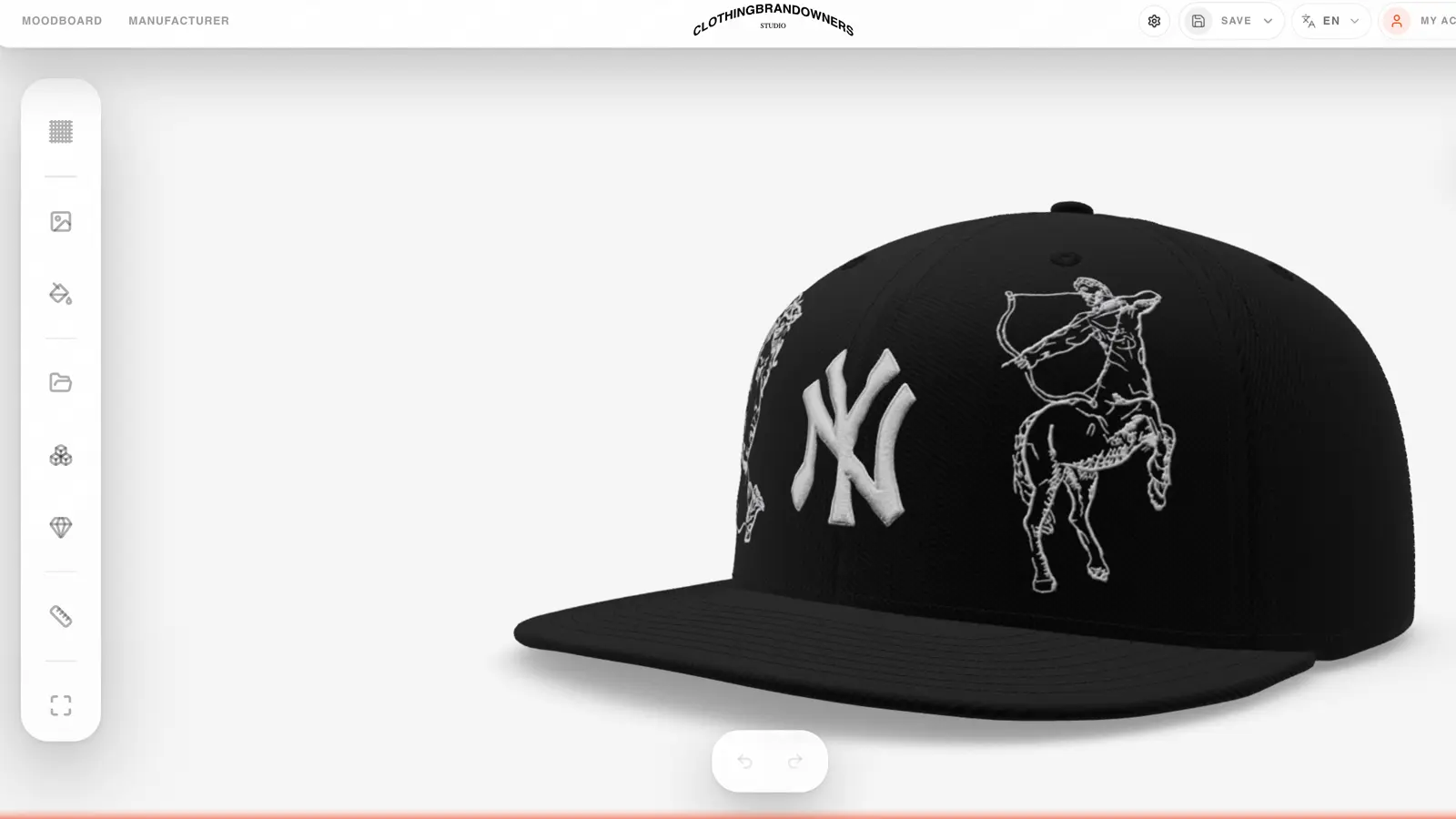
Real Studio options on the flat-fitted model — proportions, hardware and stones judged before anything is cut.
The true flat-fitted silhouette with a structured crown — judge proportions on the rotating model.
Suede and corduroy colorways with fabric-aware recoloring, plus a suede brim option.
Metallic top pins, buttons and labels — even generate a custom 3D metal pin from your logo with AI.
True displacement puff embroidery and paintable rhinestones for statement pieces.
A fitted cap has no adjuster. That single fact changes how a run is planned, stocked and sold — and it is the reason a lot of first drops choose a snapback instead.
The fitted range runs from 6 7/8 to 7 3/4, with no closure on the back of the cap. Each size is a separate manufactured item, not a strap position — which is exactly why the cap fits the way it does and why it costs more to stock.
A run of adjustable caps is one SKU. A fitted run is several. Decide how your quantity should be split across the range before production starts, and confirm that split with the production team — it is easier to plan than to correct.
For giveaways, events, gifting or a first test drop, an adjustable closure sells every unit you make. Fitted sizing earns its complexity when the cap is a retail product people choose deliberately — see the event-order planning notes for the same trade-off from the other side.
Structure is not a comfort feature on this cap — it is the decoration budget. Every technique on the embroidery and patch list is available here, which is not true of any softer build.
Six panels with fitted sizing and buckram behind the front, so the crown stands up on a shelf as well as on a head. Retail photography and unboxing both depend on that — a cap that collapses in the box looks cheap before anyone tries it on.
The structured high-crown build supports dense flat embroidery, large 3D puff and chenille letters. This is the cap where a heavy stitch count is a design choice rather than a construction risk.
Small side-panel embroidery is a fitted convention rather than an afterthought — a secondary brand mark, a number, a city. It is the detail that most clearly separates a considered fitted from a decorated blank.
The flat brim stays rigid, which is what makes the retail sticker plausible: matte, holographic or die-cut, carrying your brand and the size. On a fitted, the sticker is part of the product, not packaging.
Soft-enamel and hard-enamel pins attach to the front panel and need a structured surface to sit flat against. On a fitted they land cleanly and stay put. In the Studio you can preview them in place — and generate a custom 3D metal pin from your own logo before deciding whether the cap needs one at all.
See the metallic pins previewProportion first. On a high-crown flat-brim cap, the relationship between crown and brim decides more than the artwork does.
The fitted loads in the browser on desktop, iPhone or iPad with its true high crown and flat brim. Free to start, nothing to install.
Rotate the cap before adding anything. Crown height against brim width is the proportion buyers read first, and it is the hardest thing to correct once artwork is committed to it.
Front mark, side-panel mark, hardware, stones. Preview puff as real displacement and paint rhinestones directly onto the surface with a brush, controlling size and spacing as you go.
One physical fitted cap for $60, usually about 7 days. After approval, bulk runs from 50 pieces at roughly $10-15 a cap, about 14 days.
Premium caps sell on details a flat template cannot show: brim edge, crown profile, hardware shine, puff height.
| Flat mockup | CBOs | |
|---|---|---|
| Proportions | One pasted front view | Crown, brim and profile from every angle |
| Materials | A texture overlay | Real suede and corduroy that recolor without dying |
| Hardware | Invisible | Metallic pins, buttons and labels rendered in place |
| Next step | Export a JPEG | Order the physical sample of that exact cap — $60 |
CBOs manufactures the cap rather than decorating a blank, so sizing, structure and hardware are all specification rather than catalogue. The route is the same one sample, then bulk as every other style.
About 7 days. On a fitted the sample proves two things a render cannot: whether the crown holds its shape unworn, and whether the hardware sits flat against the panel it is attached to.
Bulk starts at 50 per model and colorway, roughly $10-15 a cap, about 14 days after approval. Plan the size split alongside the colorway split, not after it.
Satin lining, woven label, inside taping, brim sticker, hangtag, and an authentication card with an edition number or drop name for limited runs. Add a rigid box and the cap arrives as a product.
The fitted range runs from 6 7/8 to 7 3/4, with no closure on the back. Each size is manufactured separately, so a fitted production run has to be planned across a size curve rather than treated as a single interchangeable SKU.
Yes. Soft-enamel and hard-enamel pins attach to the front panel, and the structured build is what lets them sit flat. In the 3D Studio you can preview them in place, and generate a custom 3D metal pin from your own logo before deciding on the final layout.
Yes. Heat-set rhinestones are applied in defined patterns, letters or logo shapes — the technique behind club, festival and premium drop caps. You paint the placement directly onto the 3D cap with a brush, controlling size and spacing before sampling.
A snapback run is one adjustable size, so every unit is sellable. A fitted run has to be split across a size curve, which means holding stock you cannot substitute. Fitted caps read more premium; snapbacks are simpler to sell through. Try the same design on both models before deciding.
Satin lining is standard on fitted and premium builds. Alongside it you can specify inside taping over the crown seams, a woven brand label, a satin care label and a branded sweatband as part of private label finishing.
One physical sample for $60, usually about 7 days, then bulk from 50 pieces per model and colorway at roughly $10-15 per cap, about 14 days after sample approval.
The fitted sits at the structured end of the range. These are its neighbours.
The same buckram-backed front and flat brim, with an adjustable snap instead of fixed sizing.
Where pins, stones, suede and boxed packaging come together as a drop rather than a single cap.
The unstructured opposite: low, soft and built for flat embroidery rather than hardware.
A structured front with a mesh back — the same decoration surface, cooler to wear.
Set the proportion, layer the hardware, approve one physical cap for $60, then produce the run.